
GROWING OPPORTUNITIES FOR MANUFACTURING
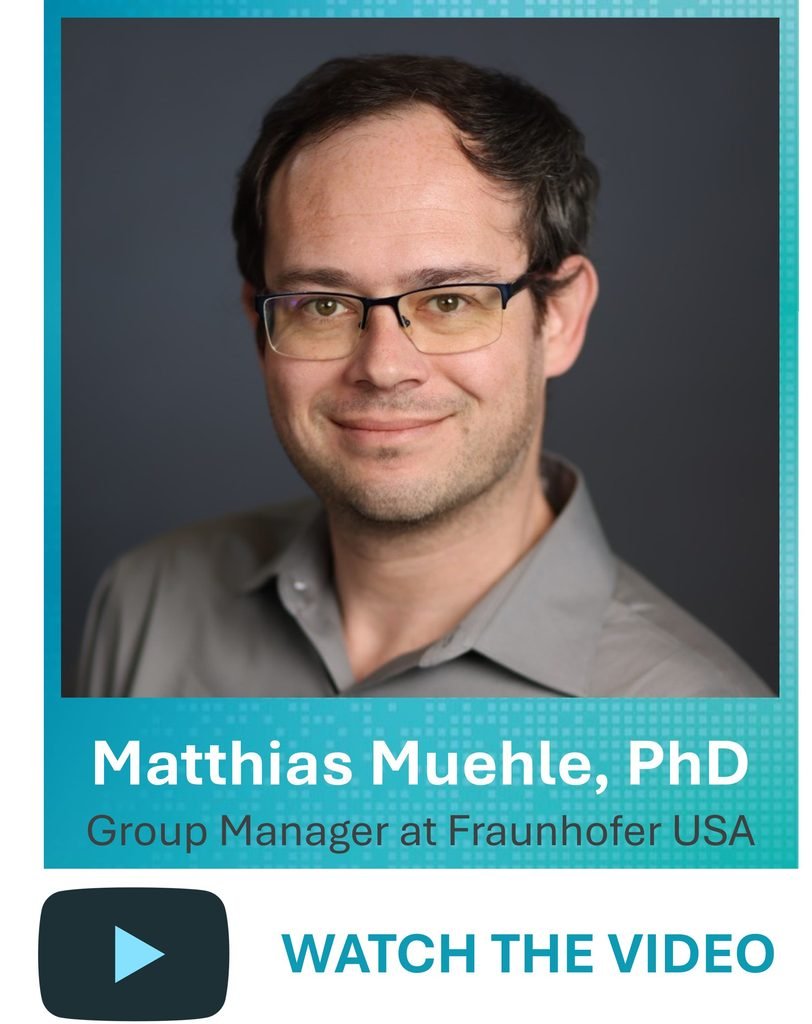
For Matthias Muehle, Manager of Diamond Technologies at Fraunhofer USA, diamonds are an engineering material, and Michigan State University is one of the best places in the world to work with them. On December 8 at Automation Alley, Fraunhofer USA is inviting Michigan manufacturers into the room to help shape how AI is used in advanced manufacturing.
First, it helps to know who you’d be sitting down with.
A material with deep roots. Man-made diamond is nearly an 80-year story. In the late 1950s and early ’60s, GE and a Swedish company pioneered high-pressure, high-temperature presses that turned carbon into industrial diamond for cutting, grinding and polishing. Muehle’s team works differently, using chemical vapor deposition. Hydrogen and methane are fed into a reactor, where microwave energy creates a plasma, much as a kitchen microwave heats food. A series of chemical reactions then grows diamond on a substrate. It’s the same basic approach behind lab-grown gems, except Fraunhofer engineers the material for specific applications.
Register for the December 8 workshop
The groundwork was laid in the ’70s, ’80s and ’90s. By the early 2000s, the field was moving toward practical uses, and Muehle says we’re now in a rising phase. Diamond has the highest thermal conductivity of most known materials, which makes it a natural fit for challenges like cooling chips in data centers. His group’s work spans semiconductors and automotive uses, plus two other teams: one building diamond-based electrochemical and neural sensors (carbon is biocompatible), the other using conductive diamond for water treatment, including PFAS, a major concern in Michigan.
The Fraunhofer model. Fraunhofer was founded in Germany in 1949 and is the world’s largest applied R&D organization. Its purpose is to bridge the funding gap between university research and industry’s internal development, roughly TRL 4 to 7. In Germany, the government covers about 20% of the budget, and the rest comes from collaborative research and prototype work for industry.
Why Michigan? Fraunhofer USA’s Midwest center began as a satellite of a Dresden institute focused on thin-film coatings. After stops in Ann Arbor and Peoria, it found a lasting home at Michigan State, where Muehle’s PhD advisor, Jes Asmussen, was a world leader in diamond deposition and reactor development. Fraunhofer USA brought coatings expertise, MSU brought diamond, and a carbon materials center was born. Proximity to the automotive industry sealed the case.
Why this matters for December 8. This expertise is local, and the December 8 workshop is your chance to meet the people behind it in person. The event is free, and the organizers aren’t there to sell you anything. They want to hear what your company needs. If you work in manufacturing in Michigan, a team with this much depth in materials and applied research is listening.
Register for the December 8 workshop
Next: Part 2 shows what Fraunhofer’s process looks like in practice, from a product you can find at Home Depot to the students who help make it happen.



Recent Comments